Google Maps Ranking: Why #1 Depends on Where You Search From
Transcript
0:00 The same search, two spots: #1 at the door, #19 two miles east
Picture lunchtime on a Wednesday in Phoenix. Someone just cracked their tooth. They pull up their phone and type one word, dentist. If you search from this office’s own front door, it comes up number one. Search from two miles east and it’s number 19.
0:15 Why your Google Maps rank changes with where people search
That’s not a glitch. Local results change with where you search from. BrightLocal asked consumers where they started their last search for a local business. Six in ten said Google. The map box in Google’s results usually shows just three businesses. Everyone else is behind a click. And those three spots matter. A marketing company compared the businesses in the top three with businesses ranked four to 10. The top three got almost twice as many calls, website clicks and direction requests.
And this isn’t a dentist thing. Whether you run a restaurant, a daycare, a cafe, or a home service business, this is how people find you. So you should aim to rank first, but also first from where.
I’m Ala Al-Shaibani, I run Mazaya Digital, and this map is the first thing I pull before I recommend anything to a local business. This is the Market Visibility part of the MOSAIC Six, my framework for growing local businesses. Here’s the simple version.
1:09 You don’t have a rank, you have a radius
You don’t have just one rank, you have a ranking radius, the area where you show up near the top, and it’s rarely a neat circle. Google says it in its own help pages. Distance is how far each business is from the customer who’s searching.
1:24 Every street has its own result
So every street gets its own results. Near your door, distance works for you. A mile out and distance starts working for other businesses that are closer to that searcher. So how far your reach goes depends a lot on your competition. Where there are fewer businesses like yours, it usually stretches further. Where they’re packed in, it shrinks.
You can’t change distance, but Google names two other things: relevance, how well your profile matches the search, and prominence, how well known your business is.
1:53 One office, the whole map: 169 searches for “dentist”
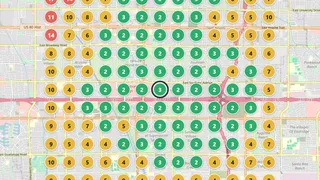
Let’s go back to that Phoenix office. We searched dentist from a grid of spots all around it, as if someone were standing at each spot with their phone, and recorded the office’s rank at every spot. Green means top three, then yellow, red, and gray as you drop down the list.
At the office’s location, number one. Right around the office, it’s mostly green, which means they have strong visibility. Go two miles east or west, and it’s way down the list. Go north and south, and it holds up better. So the reach stretches in some directions and shrinks in others. Add it all up, and this office is in the top three on only a small part of this map.
Now look at who’s winning everywhere else. 26 different dental offices are number one somewhere on this map. The office that wins the most of this map, it’s almost three miles from where we started.
One more thing, this is a snapshot. Search again next week and some of these dots may change color. That’s why we use a map like this for direction, not as a rigid score. What we focus on is the number of calls, website visits and leads you get.
2:58 “We rank first”: the three things to ask for
So here’s what to ask for from your agency or to check yourself. Number one, the map of your area: not one search from your desk, but searches from spots across the whole area you serve. Number two, your top three share. How much of that area sees you in the top three? Not just your best rank. Number three, the highest top three share on that map. Who holds it? Is it you or another business? That tells you roughly where the ceiling is in your market. And in a crowded market like Phoenix, even the leader only holds part of the map.
3:30 Six things you can work on for Google Maps visibility
Once you know where you’re missing, work on the two things you can change, relevance and prominence. Here are six places to start.
Number one, a website that clearly says what you do. A page for each main service in plain words. It tells Google, AI and your customers what you’re relevant for.
Number two, your Google Business Profile categories. Pick the primary category that best describes your business, and add more categories for the things you really offer.
Number three, a complete profile. Fill in the details that apply, from services and products to parking. Keep your description and hours accurate, including holiday hours. Google says complete, accurate information makes businesses more likely to show up.
Number four, reviews. Ask your customers for them, and reply to them. Reviews are other people vouching for you, and Google says more reviews and positive ratings can help your ranking.
Number five, real photos and videos of your place and your work. Help people see what to expect.
Finally, number six, citations and backlinks. Citations are listings of your business details on other sites, like directories. Keep your name, address, and phone number the same everywhere.
4:36 The two kinds of backlinks
Backlinks are links from other websites to yours, and they come in two flavors. Links from sites in your industry build topical relevance. They tell Google what you do and tend to make you stronger where you already show up. And links from local sites, like your Chamber of Commerce, a sports event you sponsor, or a local award, build geographic relevance. They tie you to your area and tend to help your reach spread further out.
None of these is a guarantee, but they’re the levers. In future videos, I’ll dive into the specifics of each one.
5:06 Bonus: what ChatGPT shows and cites for local questions
And there’s a bonus. When we tested local questions in ChatGPT, its answers cited Google Maps listings and review sites. So the same work may help you there too. It’s a different system though, and it gets its own video later in the series.
5:19 Three things to take away
Three things to take away. Number one, you don’t have just one rank. You have a ranking radius, and it changes street by street. Number two, the map box usually shows just three businesses. Measure how much of your area sees you there, and keep measuring, because Google keeps changing how results look. And number three, use the map for direction, not as a score. What really counts is your leads.
If you run a local business and want to see where you rank on Google Maps, request a free map check through the link in the description. I’ll check one main service in one location and email you a map of your local rankings with a short description.
Now, say your reach is wide: people find you, visit your website, and still don’t call. Why? I’ll cover that in an upcoming video. Subscribe, and you’ll get it when it’s out.
Sources
- BrightLocal, Consumer Search Behavior survey: 1,227 US consumers; 52% started their most recent local business search on Google Search and 9% on Google Maps.
- Google Business Profile Help, “Tips to improve your local ranking on Google”.
- SOCi, “Top Ranking and Conversion Factors for Local Search” (300,000 Google listings): listings in the map’s top three earned 126% more search traffic and 93% more calls, website clicks and direction requests than listings in the Local Finder, the list behind the top three.
- The Phoenix map: measured by Mazaya Digital. 169 searches for “dentist”, half a mile apart, on mobile, ads not counted.
- Mazaya Digital’s own ChatGPT tests on local questions: the business cards in the answers carry the Google Business Profile’s rating and review count; the text cites review sites and directories.
- Map data © OpenStreetMap contributors, available under the Open Database License.